If you are anything like me, you have likely uttered the phrase, “I just don’t have enough time,” at least once this week. Maybe even once this hour.
We treat time like this scarce commodity that is constantly slipping through our fingers. We buy the planners, we color-code the calendars, and we try to play “whack-a-mole” with our to-do lists. But what if I told you that time management is actually the problem, not the solution?
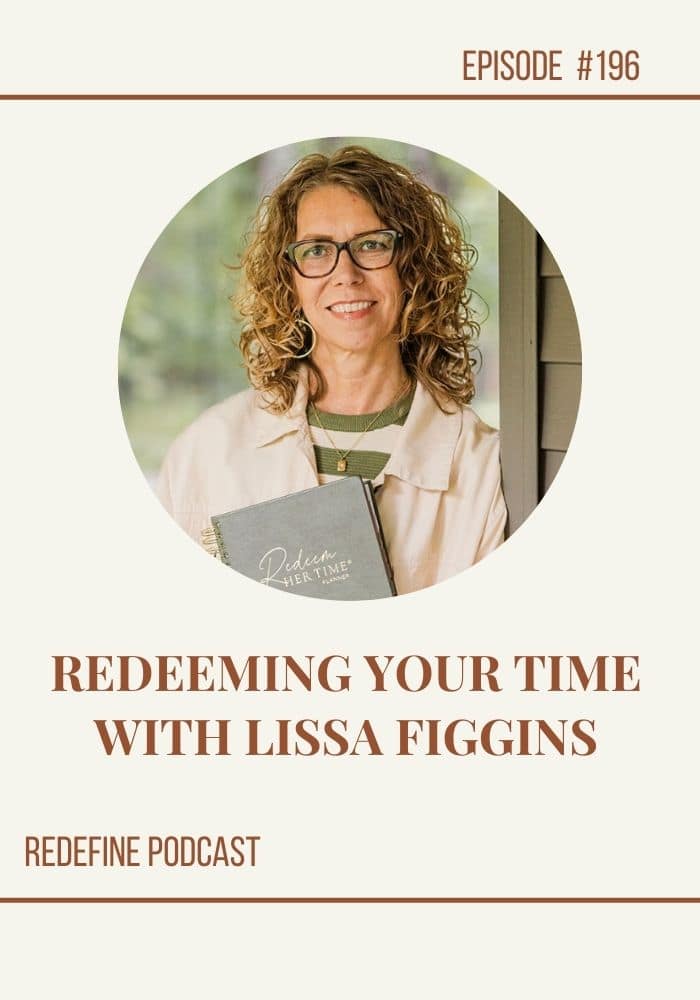
On this week’s episode of the Redefine Business Podcast, I sat down with the incredible Lissa Figgins. Lissa is a Time Scaling Strategist (I love that title!) who works with Christian women and business owners to help them unlock the results they want by changing their relationship with the clock.
As we look toward a new year, this conversation is absolute gold. We dig into why you need to stop “managing” time, how to get a better Return on Time Invested (ROTI), and the “Skittles vs. Oranges” analogy that will completely change how you pack your day.
Grab your favorite beverage, sit back, and let’s redefine how we view our 24 hours.
From “Time Management Ninja” to Scaling Strategist
Lissa didn’t start out as a guru with all the answers. In fact, she describes herself as the former “poster child” for toxic time management. She was the girl in school who wrote assignments in her planner after she did them just to get the dopamine hit of checking them off.
But as she became a wife, a mom of three, a teacher, and a leader in her community, the strategy of “hustling harder” stopped working. She was doing all the things, but she wasn’t present for any of them.
Lissa shared a powerful story on the podcast about a health scare that changed everything. She developed a sensation of a ball in her throat. After seeing specialists and fearing the worst, a doctor finally diagnosed her with Globus Hystericus. In plain English? She was so stressed and anxious from trying to control everything that her body was physically manifesting a lump in her throat.
The doctor told her she was “crazy” (in a medical sense!) with anxiety. That was her wake-up call. She realized her busyness wasn’t a “disordered calendar” problem; it was a “disordered heart” problem. She was chasing “enoughness” through doing, and it was costing her everything.
The Problem with “Managing” Time
Lissa dropped a truth bomb that resonated so hard: Time management implies we are just trying to contain the chaos.
Think about a manager at a fast-food restaurant during the lunch rush. They are running around, putting out fires, and just trying to keep the ship afloat. That is how most of us live our lives. We get our ducks in a row, and then life happens, the ducks scatter, and we spend the rest of the day chasing them.
Instead of management, Lissa teaches Time Stewardship.
We don’t own time. We didn’t create it, and we can’t bank it for tomorrow. We are given a gift of 24 hours every single day. A steward doesn’t just hide the money under the mattress (or waste the time scrolling social media); a steward invests it to get a return.
3 Shifts to Multiply Your Time in 2026
If you are ready to stop feeling behind and start feeling abundant with your time, Lissa outlined three specific mindset shifts you need to make.
Shift #1: Change Your Belief
You have to stop saying, “I don’t have time.” Lissa pointed out that we often say we don’t have time for our health, our Bible study, or our business growth, but we can easily tell someone about the latest Netflix series we binged or the hour we lost to Instagram.
We all have the same amount of time. It is the great equalizer. When you catch yourself saying “I don’t have time,” pause and remind yourself: I have time. It shifts you from scarcity to abundance.
Shift #2: Move from Management to Stewardship
As we mentioned above, stop trying to control every second and start trying to multiply your results. Lissa calls this ROTI: Return on Time Invested.
Just like money, you can waste time, spend time, or invest time.
Wasting it: mindless scrolling.
Spending it: doing necessary tasks that don’t move the needle (like buying a coffee—it’s gone once you drink it).
Investing it: doing things that expand your life, business, or relationships.
Unlike money, however, you can’t earn more time. Once today is gone, it’s gone. So, are you stewarding it well?
Shift #3: Change the Question
What is the number one question we ask ourselves every day? “What time is it?”
As soon as we ask that, our shoulders tense up. We look at the clock, realize we are “late,” and start rushing. Lissa suggests a tiny tweak that changes everything. Instead of asking “What time is it?”, ask: “What is it time for?”
This question grounds you in the present moment. It stops the multitasking (which, by the way, Lissa notes makes us make 40% more mistakes and takes 50% longer). When you know what it is time for, you can be fully present, whether that is writing an email, playing with your kids, or sleeping.
Capacity by Design: Skittles vs. Oranges
I love a good visual, and Lissa shared one that I am definitely going to use. It’s called Capacity by Design.
Imagine you have a jar.
The Skittles: These are the random notifications, the “got a minute?” interruptions, the scroll holes, and the busy work.
The Oranges: These are your faith, your family, your health, and your core business projects.
Most of us fill our jars with Skittles (the small stuff) all day long. Then, when we try to shove an Orange in (like a date night or a big project), there is no room. The jar is full of sugar-coated distractions.
But, if you put the Oranges in the jar first, and then pour the Skittles in, the Skittles will fall into the cracks and spaces around the Oranges.
Everything fits.
You have to identify your Oranges and anchor them into your day before you let the Skittles take over.
Establishing Time Zones
To make this practical, Lissa suggests viewing your day in “Time Zones.”
Refill Zones: These are usually morning and evening. You cannot pour from an empty cup. You need to refill your body, mind, and spirit. For Lissa, this looks like her morning pour-over coffee and Bible time.
Pour Out Zones: This is the time between the refill zones where you pour into your work, your family, and your household.
The mistake we make is trying to “pour out” (work) during a “refill” zone (late at night in bed). Keep your zones sacred, and you will find you actually get more done.
Final Thoughts
Time isn’t the enemy. It is the opportunity. Whether you are looking back at the past year with regret or looking forward to 2026 with anxiety, remember that you have enough time for what you are called to do.
Stop chasing the time you think you don’t have, and start stewarding the time right in front of you.
If you loved these nuggets, Lissa has a free private podcast series that breaks this down even further. Check out the links below!
Connect with Lissa Figgins
Other Links:
Join the Community:
Join Lissa’s free Facebook community for business owners to network and grow.
Podcast: Check out the Redeem Her Time Podcast wherever you listen!
Join the Conversation
Let’s not stop the party here. Head on over to my Instagram or Facebook group, Redefine Your Business, and share your thoughts about today’s show. See you again, same time, same place next week!
Resources:
The Meeting Place Membership
Rock The Reels
1:1 Coaching
Free Client Welcome Guide
Additional Trainings and Resources
Connect with Brittni:
Follow me on the Gram – @brittni.schroeder
Join my Facebook Group
Visit my website
Subscribe to my Youtube