When you’re building an online business, it can feel like the rules keep changing. One minute everyone is talking about Instagram growth, the next minute it’s TikTok, and now suddenly the conversation has shifted to AI tools like ChatGPT, Gemini, and Perplexity. If you’ve felt a little overwhelmed keeping up — you’re in good company.
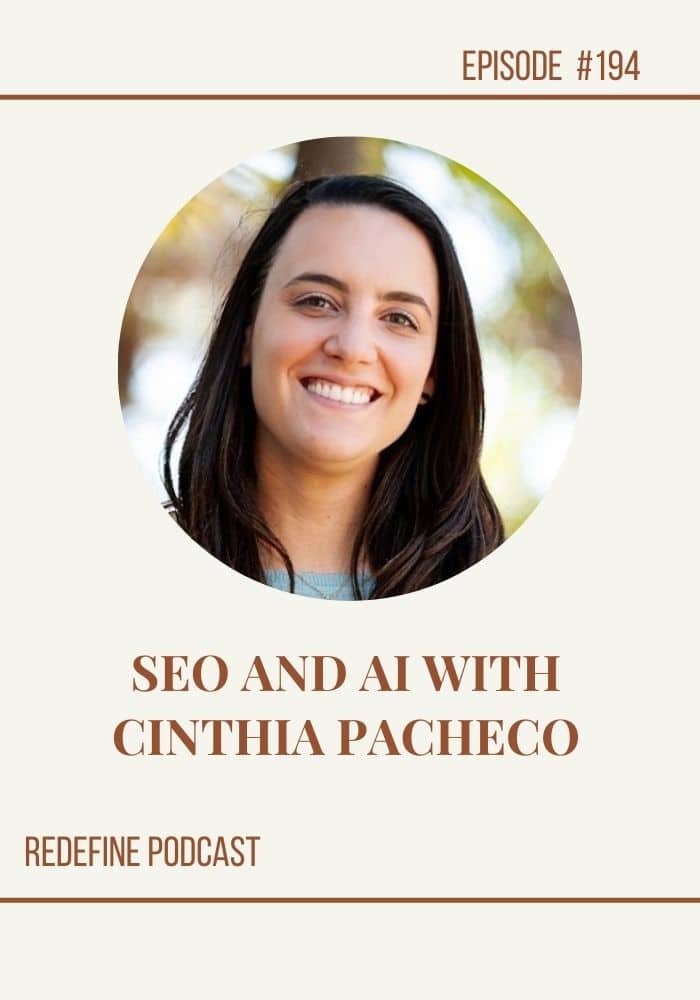
In this week’s episode, Brittni sits down with SEO expert and founder of Digital Bloom IQ, Cinthia Pacheco, to demystify all things SEO, AI search, keyword strategy, and content creation — and to help you understand how to actually make SEO work for you without burning yourself out.
As Brittni shares in the episode, many business owners are saying loud and clear: “I don’t want to be on social media all the time.” They’re tired, overwhelmed, and craving a more sustainable way to drive traffic and reach people. And that’s exactly why SEO — though never gone — is having a major resurgence.
Why SEO Is More Relevant Than Ever
Cinthia explains that SEO (Search Engine Optimization) has always been about meeting people at the exact moment they’re searching for what you offer. That timing is meaningful: while social media requires you to push content and hope the algorithm shows it, SEO brings people in when they’re actively looking for solutions.
Whether someone is searching for:
- “How do I grow my business?”
- “Best courses for new entrepreneurs”
- “How to build funnels”
- “Best tools for online coaches”
…SEO helps position your website as the answer.
But SEO no longer exists in a bubble. Today, tools like ChatGPT and Gemini are becoming search engines of their own. Cinthia explains that these platforms are learning from website content the same way Google does — which is why strong content matters more than ever.
Blogging Isn’t Dead — It’s Just Evolved
One myth Cinthia was eager to bust? That blogging is dead.
Blogging isn’t about being a “blogger” anymore — it’s about publishing high-quality, helpful, searchable content on your website in any format you want:
- Tutorials
- Case studies
- Resource pages
- Guides
- FAQ pages
- Articles
- Notes
- Journals
Call it whatever you’d like — what matters is that your site contains content that answers people’s questions. Cinthia encourages business owners to think of their website as a resource hub for both warm leads and brand-new visitors who are still figuring out what solutions they need.
Brittni emphasizes this too: she encourages new business owners to commit to creating at least 50 pieces of high-quality, optimized content. SEO is a long game. But unlike social media, which disappears in 24 hours, SEO content continues to work for you for years.
Keywords, AI, and the Shift Toward Topic Clusters
The heart of SEO has always involved keyword research — but keyword strategy is evolving rapidly.
Cinthia shared that in an AI-heavy world, search tools no longer rely solely on short, mechanical keyword phrases like “business coaching” or “marketing tips.” AI tools are interpreting longer, more conversational user queries and pulling from websites that offer deep, thematic content rather than isolated keywords.
This is where topic clusters come in.
A topic cluster is a group of related articles that all support one major topic. For example, if Brittni is targeting “business growth,” her cluster might include posts like:
- How to grow your business without burnout
- How to choose the right funnels for your business
- What to automate first when scaling
- Best tools for solopreneurs
- How to build an email nurture sequence
AI tools love topic clusters because they show depth, authority, and clarity. Cinthia explains that AI is more likely to pull answers from websites that show true expertise — not surface-level content or repeated keyword stuffing.
SEO + AI: How They Work Together
Even though AI search feels new, the foundation of SEO still matters — it just has an additional layer now.
Traditional SEO still includes:
- Fast-loading pages
- Clean site structure
- No broken links
- Quality outbound and inbound links
- Page titles and headers optimized for clarity
- Helpful, original content
The AI layer adds elements like:
- Schema markup (helps AI tools interpret your site)
- Topical depth
- Unique case studies, experiences, and stories
- Authority building on other platforms
- Content repurposed into formats AI prefers
This is why AI hasn’t replaced SEO — it has expanded it.
Cinthia reminds listeners that if everyone is using AI to generate content, the bar for quality and uniqueness has risen. Adding your unique stories, client wins, personal experiences, and your own frameworks gives Google and AI tools something no one else can offer.
Authority Building: Beyond Traditional Backlinks
Backlinks used to be the gold standard of SEO — and they still matter. But authority today is built in more ways than one.
Cinthia points out that platforms with high authority — like LinkedIn, YouTube, Reddit, and even podcast directories — help strengthen your credibility. This doesn’t mean copying and pasting your full blog posts onto LinkedIn (which creates duplicate content), but rather:
- Writing original articles for those platforms
- Repurposing content into shorter posts
- Answering questions on Reddit
- Appearing on other podcasts
- Using YouTube as a search engine
These platforms reinforce your authority in ways AI and Google recognize.
The Biggest SEO Tip? Ask Your Audience.
When it comes to keyword research, Cinthia offered a surprisingly simple tip:
Just ask your audience what they search for.
Send a survey.
Ask on Instagram Stories.
Include a question in your onboarding form.
Or ask clients during calls.
You’ll be shocked at how simple people’s actual search phrases are — and how different they often are from what business owners assume.
Brittni adds that asking your audience regularly is also a great way to develop future content, courses, and offers. Sometimes the most basic questions your audience asks are the exact topics your SEO strategy needs.
Creating Content That Works for People and Search Engines
Cinthia encourages business owners to stop reinventing the wheel. Use what you already have:
- Turn a video into a blog.
- Turn a podcast episode into five articles.
- Turn social media questions into tutorials.
- Turn email replies into content pillars.
- Transcribe a Reel and expand it into a blog.
AI can help refine your ideas — not replace your voice.
SEO becomes much more manageable when it feels like repurposing instead of starting from scratch every time.
How to Connect with Cinthia
Cinthia Pacheco is the founder of Digital Bloom IQ, a digital marketing agency specializing in SEO, paid ads, and AI-informed marketing strategy. She also offers educational programs for entrepreneurs who want to learn SEO or understand AI search.
Freebie:
https://courses.digitalbloomiq.com/module-0
You can find Cinthia at:
Website: digitalbloomiq.com
Instagram: @digitalbloomiq
Email: Cinthia@digitalbloomiq.com
Final Thoughts
If social media feels overwhelming, exhausting, or unpredictable — SEO might be the sustainable solution your business needs. SEO allows you to build long-term visibility, attract ready-to-buy clients, and share your expertise in ways that continue working for you long after you hit “publish.”
Cinthia’s biggest message?
SEO is not dead.
Blogging is not dead.
Long-form content is not dead.
Bad content is what’s dead.
If you create thoughtful, unique, useful content — and you stay consistent — your website becomes an asset that grows in value year after year. And in the world of business, that’s one of the smartest investments you can make.
Join the Conversation
Let’s not stop the party here. Head on over to my Instagram or Facebook group, Redefine Your Business, and share your thoughts about today’s show. See you again, same time, same place next week!
Resources:
The Meeting Place Membership
Rock The Reels
1:1 Coaching
Free Client Welcome Guide
Additional Trainings and Resources
Connect with Brittni:
Follow me on the Gram – @brittni.schroeder
Join my Facebook Group
Visit my website
Subscribe to my Youtube